
There is a lot that goes into a Golden Tee course before players ever get a chance to tee it up.
For Senior Game Designer Jim Zielinski, it can start with a real golf course, an interesting landscape, a location players haven't seen before or even an idea submitted by a Golden Tee player years earlier. Sometimes it means looking backward, which is exactly what happened with Champ ‘96.
With five new courses coming to Golden Tee PGA TOUR 2027, 18 years of Design-A-Hole submissions now being used to create an entire course, and a 30-year-old course coming out of the archives, there is plenty to talk about.
So, we sat down with Jim Z to get a look behind the scenes at how some of these decisions actually come together.
When Jim starts looking for new course ideas, he doesn't necessarily begin with a blank sheet of paper. Real golf plays a big part in the process.
“I think we always look for interesting places to golf,” Jim said.
Sometimes that means finding a well-known golf destination and putting a Golden Tee spin on it. Other times, the landscape itself is enough to get the creative process moving.
“I use real golf for a lot of that inspiration,” he said. “If there's an interesting landscape somewhere, I'll look at that too and say, oh, this is really kind of unusual landscape that might be fun to put a golf course there.”
Jim said he spends a lot of time researching potential locations between Golden Tee releases, building up a list of places that could eventually become courses. From there, the team talks through the possibilities and decides which locations stand out.
That also means Golden Tee can revisit an area without simply recreating what came before. Jim pointed to California's coast as an example, where the game has previously featured courses but can still explore more of the same region.
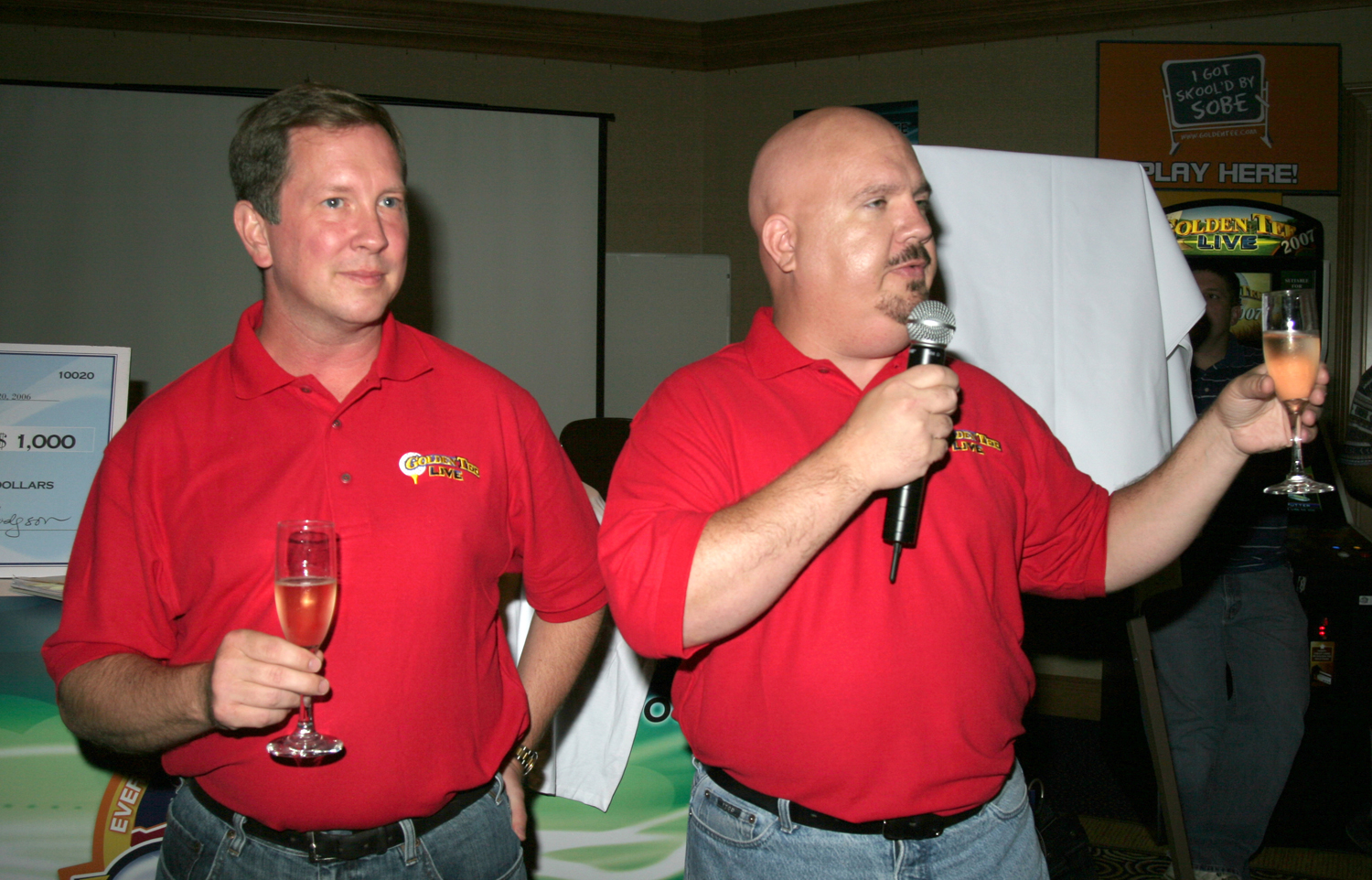
From left to right: Larry Hodgson, Senior Vice President & Jim Zielinski, Senior Game Designer
As for why all five 2027 courses are set in the United States, there wasn't some larger plan to leave international locations behind.
“It wasn't intentional to keep it US, but... the ones we chose were U.S.”
Sometimes that's just how the list shakes out.
Design-A-Hole has been around for 18 years, and that has given the team quite a collection of player-created ideas to work with.
Turning one of those submissions into an actual Golden Tee hole isn't always as simple as taking a drawing and recreating it. Jim and the team have to make sure the idea works within the scale and structure of the game.
“The ones where we have to really stretch or shrink that won't maintain the original design, we kind of toss because we'd have to do so much rework to their original design that it wouldn't really work,” Jim said.
That has actually made the process easier over the years. The team has gotten better at identifying which designs can translate into playable Golden Tee holes without losing the original idea.
Jim said, “We look for stuff that is unique, that we haven't seen before, played before.”
And if a great submission doesn't fit the course lineup for that particular year, it isn't necessarily gone forever. Many players have submitted their design more than once over the years.
That makes the new Design-A-Hole course in 2027 a pretty unique payoff for something that's been part of Golden Tee for nearly two decades. Player ideas that once existed as drawings and descriptions are now becoming a playable experience.
If you've been around Golden Tee for a while, you've probably heard the name Champ ‘96 before. For most players, that's about all it has been: a name from the past.
Jim remembers exactly why courses like it existed in the first place. Back during the mid 1990s era, Jim would create courses specifically for national championship events. The players competing on them hadn't seen them before, which meant they couldn't simply rely on memorized shots.
“It was, here's a course you've never seen before. How good of a golden tee golfer are you to improvise on the spot?”
The format eventually created another issue, though. Because the courses were difficult and unfamiliar, championship scores were considerably lower than what players were used to seeing.
“We were getting scores like -18, -19 as winning scores,” Jim said.
That made it difficult from a promotional standpoint because someone seeing a -18 might assume that was a typical winning score, without realizing the players were competing on courses they had never played before.
The courses were eventually moved away from the championship format, but they didn't disappear. They stayed in the archives. And Champ ‘96 had been sitting there since, 1996.
“That one course from 1996 hasn't been played since 1996. Let's bring this back.”
The re-teed courses may look like a simple way to give familiar courses some new life, but there's a process behind deciding which ones get the treatment.
Jim said the first thing the team looks at is popularity. If players aren't playing a course very often, it's probably not going to be near the top of the list.
After that comes the age of the course. The earliest Golden Tee courses can present some challenges because of their older artwork. The team wants the re-teed courses to fit visually with the rest of the game, so some of the oldest courses are generally left alone.
That doesn't mean those courses can never return. They could potentially be completely rebuilt, similar to what the team has done with older 3D and Golden Tee FORE courses.
Then there's the practical side of the process. Adding tees sounds simple until you get to a course with mountains, elevation changes, and very little flat space. In those situations, adding a tee without changing the rest of the course can be difficult.
So, when Jim Z boils it all down, there are three major considerations.
“So, first popularity, the age of the course, and then finally, the ease of putting the tees out there.”
It's a good explanation for why certain courses get another look while others might have to wait.
After all these years, you'd think it might be difficult to find new places to put a golf course. Apparently, that's not much of a problem.
Jim is still open to unusual locations and concepts, but there is one important condition.
“I'm open to anything that's plausible,” Jim said.
That's where Golden Tee's balance between real golf and creative design comes into play. Jim doesn't mind pushing the boundaries. A course in an unusual location can work. Lava can work. But eventually, there is a point where the game stops feeling like golf.
For Jim, that's the line he doesn't want to cross.
“Once you start making a joke of your game, then people start treating your game like a joke, and I never wanted to do that.”
It's a philosophy that explains a lot about Golden Tee's course history. The game has never been afraid to get weird, but the weirdness still has to serve the game of golf.
That doesn't mean the game has to stay grounded at all times. Golden Tee can have lava, unusual landscapes, and courses that make players stop and wonder what they just teed up on. The key is keeping enough of the game recognizable that golf still matters.
And perhaps that's the most interesting part of talking to someone who has been designing Golden Tee courses for so long. Even with 2027 bringing five completely new courses, a player-created 18-hole course, and a course that has been sitting in the archives since 1996, the basic goal hasn't changed much.
Give players something interesting to look at.
Give them a reason to think.
And, most importantly, give them a golf course worth playing.







 NEWS
NEWS